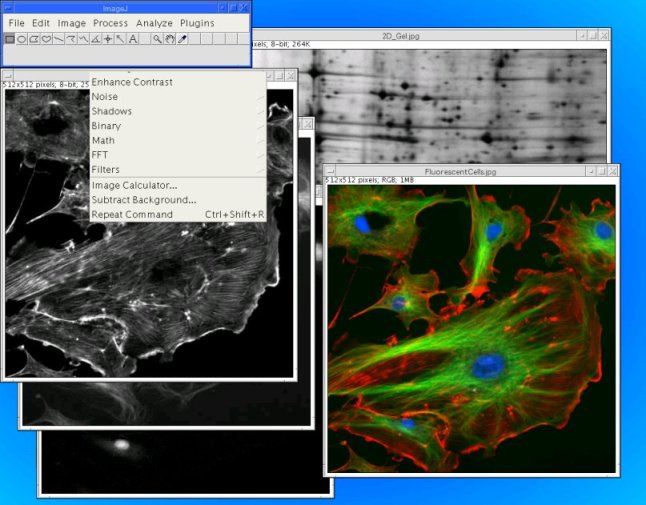
画像処理をするためのソフトといったら、 Photoshop やGimpがまず思い浮かぶでしょう。 ただ、これらのソフトは主に写真の補正や画像の合成 などといったものに使われ、顕微鏡映像の解析や ゲルの解析や細胞のカウントなどいわゆる 科学的な画像の操作には不十分なところがあります。 もちろん、上記のソフトでできないことはありません。 しかし、科学的な画像解析には、以前から NIH Imageという Mac用のソフトがよく使われていました。
最近になって、このNIH Imageをどのプラットフォームでも動くようにしたい ということで、NIH Imageの作者が同じ機能を持ったソフトを Javaで書きました。それが、今回紹介する ImageJです。
詳しい特徴はImageJのページを見ていただければわかりますが、 そのなかから少し抜粋します。
要は、色々読めてそれなりに速く、分析もいろいろできるということです。 また、Plug-inも豊富にあり、自分でもそれなりに簡単にかけるので、 欲しいと思った機能を自分で作ることもできます。
もし、今使っているソフトに物足りなさを感じているなら、 ImageJで実際に自分でプログラムを書いて分析するというのはどうでしょうか。 画像ファイルのフォーマットに気を取られることなく、自由に 画像処理ができます。
   <rindolf>  Pythack now was able to get the fc-solve test suite up and
              running.
       <Zuu>  eh?!
           *  Zuu solves rindolf
   <rindolf>  Zuu: http://fc-solve.berlios.de/
   <rindolf>  Zuu: I am not solvable.
   <rindolf>  I am Turing hard.
       <Zuu>  :S
           *  Zuu never heard of anything called 'turing hard'
 <joeyadams>  lol. Zuu's probabilistic, so maybe he can solve you.
       <Zuu>  but i guess i have now
 <joeyadams>  Formal definition of Turing hard: blah blah blah hard blah
              blah Turing blah.
       <Zuu>  Hahahaha :D
 <joeyadams>  Wikipedia: Given a set X in P(N), a set A in N is called
              Turing hard for X if X <=_T A for all X in X. If
              additionally A is in X, then A is called Turing complete for
              X.
 <joeyadams>  Does that clarify?
 <joeyadams>  (see http://en.wikipedia.org/wiki/Turing_reduction for the
              actual math symbols)
           *  joeyadams assumes you get the point
       <Zuu>  yeah, i think i'll have to put significant time into that,
              for me to comprehend it :)
       <Zuu>  but maybe i will, some day :P
 <joeyadams>  My point is that people like to use mumbo jumbo to describe
              more concise mumbo jumbo.
 <joeyadams>  E.g. A problem is NP-hard if it is at least as hard as all
              the problems in NP.
       <Zuu>  i undersstand enough of it, to be fairly confident that
              rindolf being turing hard, will not say much about his
              ability to be solved
 <joeyadams>  I'm guessing Turing-hard means you can't solve a problem
              with a Turing machine (e.g. the halting problem)
 <joeyadams>  (substitute Turing machine with "your computer" :) )
       <Zuu>  no, turing hard has something to do with expressiveness
 <joeyadams>  okay, Zuu > joeyadams, so I can't help you :)
           *  Zuu tickles joeyadams ^^
 <joeyadams>  A delicious apple is any fruit ��� apple that is at least as
              tasty as any other fruit ��� apple.
 <joeyadams>  In other words, apples are in the set of recursively
              nommable fruits.
   <rindolf>  joeyadams: what's up?
 <joeyadams>  I'm babbling.
   <rindolf>  joeyadams: Apple is one of my least favourite fruits.
           *  Zuu watches a number of apples that recursively NOM's
              eathother
   <rindolf>  It tends to be too commonplace.
   <rindolf>  Or simpleton.
 <joeyadams>  whoops, my logic is incorrect
 <joeyadams>  Only delicious apples are ��� the nommable fruits.
 <joeyadams>  (recursively is just a word you throw in to sound smart)
           *  Zuu NOMs joeyadams :>
   <rindolf>  joeyadams: a friend of one of my sisters said that Apple is
              his favourite fruit.
   <rindolf>  Ta-zuu!
           *  joeyadams has quit (Read error: 104 (Connection nommed by
              peer))
       <Zuu>  yeah, unfortunately a lot of people throw with a lot of
              words to sound smart :/
       <Zuu>  my favourite fruit is a recursive banana!
 <joeyadams>  although it certainly helps to use complex terminology to
              solve complex problems. As Aristophanes said, "High thoughts
              must have high language."
       <Zuu>  .. along with immutable polymorphic pears
 <joeyadams>  Zuu> I guess you have to peel it indefinitely?
 <joeyadams>  lol
       <Zuu>  Hahah, yeah :P
 <joeyadams>  I tend to eat bananas in deterministic polynomial time.
       <Zuu>  i eat them in linear time, but uses exponential space
 <joeyadams>  lol
   <rindolf>  Heh.
 <joeyadams>  eww

    -- Turing Hard
    -- ##programming, Freenode