

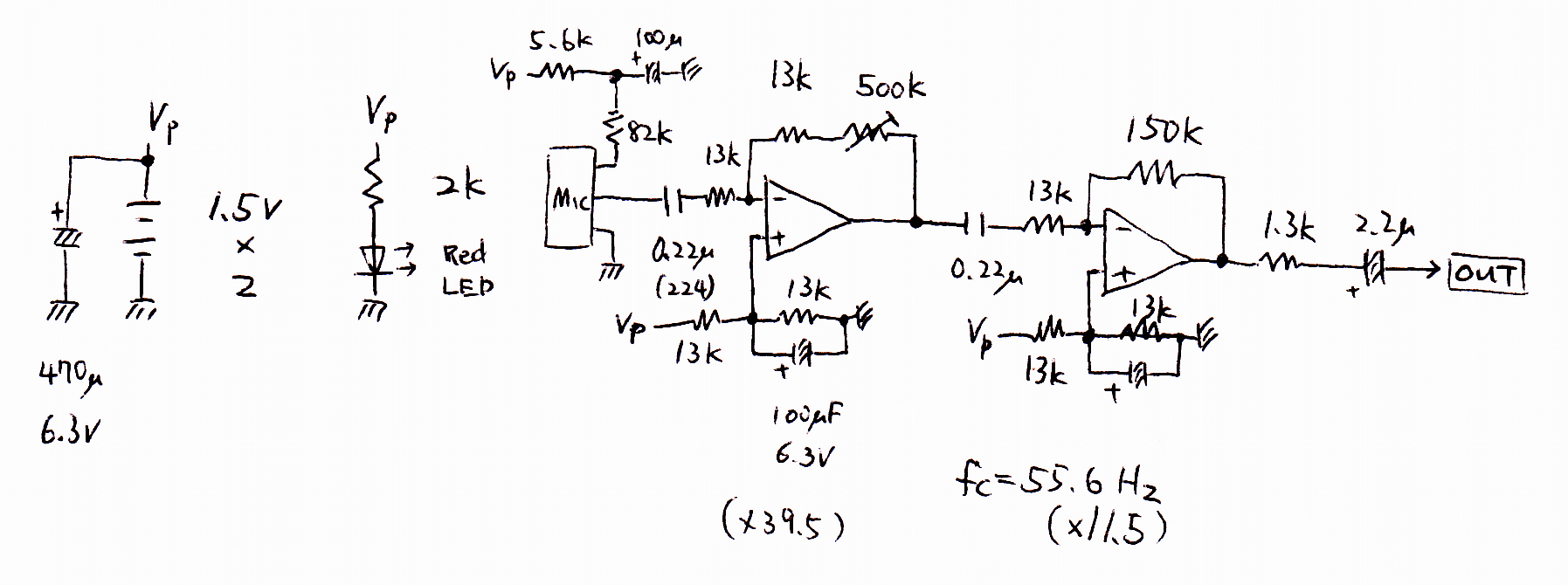
携帯電話用に良く使われているイヤホンマイク用のスタンドアロンのマイクアンプ。 オペアンプによる反転増幅回路を2段重ねた簡単なもので、それぞれのマイクに合わせてバイアス等は適宜変更する必要がある。 以下の回路では使用していないが、位相補償コンデンサを追加した方が雑音が少ないと思う。 オペアンプは単電源、入出力フルスイングオペアンプのNJM2732を採用したが、 これ以外の低電圧対応入出力レールツーレルオペアンプでもおそらく動くだろう。NJM2732は出力電流が2mA程度までしかとれないので、受け側のインピーダンスが数百Ω等の低いものは使えない。
Chandler: All right fine, don't do anything, just sit here and talk to us,
meanwhile she is talking to him about you. And he's being Mr. Joe
Sensitive,and she starts thinking 'Maybe this is the guy for me, because he
understands me.'

Joey: And before you know it, she's with him. And you'll be all, "Ohh, man!"
And he'll be all, "Yes!" And us, we'll be like, "Wh-whoa, dude." And pretty
soon you'll be like, (sadly) "Hhiii," and, and, and, "I can't go, Rachel and
Mark might be there." And we'll be like, "Man get over it, it's been four
years!!"

Chandler: He paints quite a picture doesn't he?

    -- David Crane & Marta Kauffman
    -- "Friends" (T.V. Show) ( http://en.wikipedia.org/wiki/Friends )

In the discussion about issues raised by Revenge of the Nerds on the LL1
mailing list, Paul Prescod wrote something that stuck in my mind.

束Python's goal is regularity and readability, not succinctness損

On the face of it, this seems a rather damning thing to claim about a
programming language. As far as I can tell, succinctness = power. If so, then
substituting, we get

束Python's goal is regularity and readability, not power.損

and this doesn't seem a tradeoff (if it is a tradeoff) that you'd want to
make. It's not far from saying that Python's goal is not to be effective as a
programming language.

    -- Paul Graham
    -- Succinctness is Power ( http://www.paulgraham.com/power.html )