GR-SAKURAが発売されたのは2011年末頃で、その当時はWebコンパイラかRenesasのe2 studioあたりを使うしかなかった。 Arduino類似のライブラリが公開されていなかったため、ローカルでビルド環境を整えるのは面倒であったが、 Arduinoから派生したIDE4GRという簡単な開発環境が作られ、ローカルでArduinoと同じ使用感で開発出来るようになった。 このIDE4GRの最新バージョンには、GR-PEACH(RZ/A1H (R7S721001VCBG, 外部FLASH 8MB/内蔵RAM 10MB)及びGR-LYCHEE(RZ/A1LU (R7S721030VCFP), 外部FLASH 8MB/内蔵RAM3MB) 向けのOpenCVライブラリが統合されており、これらのマイコン単体ではOpenCVによる画像処理ができる。
SW3がRUN側の時、初めの電源ONで、書き込まれたファームウエアが開始し、一回リセットするとUSB Mass storageでファームウエア書き込み可能なモードになる。 ここで書き込むと、書き込んだファームウエアが自動的に開始される。SW3がRUNと反対側の時はGeneric Boot Deviceで、RenesasのFDTでファームウエア・ブート路だ書き込みができる。
ボード上の4つあるLEDは使用できる。サンプルの初期コードはGR-KURUMI用にled = 23になっているが、GR-SAKURAではPIN_LED0、PIN_LED1、PIN_LED2、PIN_LED3で 定義されている。
	/*
	  Blink
	  Turns on an LED on for one second, then off for one second, repeatedly.

	  This example code is in the public domain.
	 */

	// Pin 23 has an green LED connected on most KURUMI boards.
	// give it a name:
	int led = PIN_LED0;

	// the setup routine runs once when you press reset:
	void setup() {
	  // initialize the digital pin as an output.
	  pinMode(led, OUTPUT);
	}

	// the loop routine runs over and over again forever:
	void loop() {
	  digitalWrite(led, HIGH);   // turn the LED on (HIGH is the voltage level)
	  delay(1000);               // wait for a second
	  digitalWrite(led, LOW);    // turn the LED off by making the voltage LOW
	  delay(1000);               // wait for a second
	}
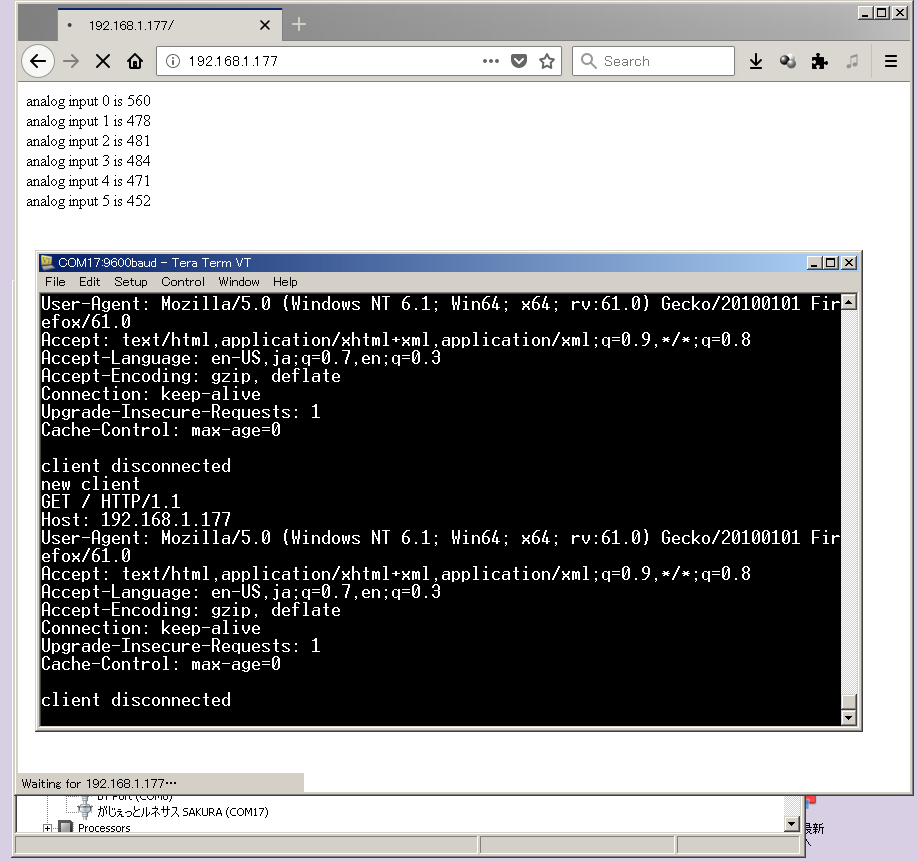
Ethernetについては、執筆時点のIDE4GR 1.03では、 GR-KURUMIはWIZ550ioモジュールを使用した上での対応、GR-SAKURA(RX63N)のみ内蔵ペリフェラル対応となっており、GR-KAEDE(RX64M)、GR-PEACH(RZ/A1H)については未対応のようであり、 IDE4GRで開発する時は、ネットワーク・画像処理等の用途によって使い分けるのが良いだろう。あるいは以前通りWebコンパイラかe2 studioを使うことになる。 GR-SAKURAのEthernetライブラリには、Renesasのスタックが組み込まれているので、ArduinoのEthernetシールドを使う要領で使用できるが、もちろんシールドは必要ない。 シリアルは、CDCのVCOMドライバを入れる必要があり、配布されているinfを使ってインストールすると良い。 このファイルは特殊電子回路謹製であるが、そのサイトによると、RX621のEthernetは100Mbpsだが、 スループットはそれほど良くなく、せいぜい40Mbpsとのことである。 COMポートを表示しながらサンプルのWebServerを走らせると、シリアルが遅いため応答に詰まりが見られる。
Hain't we got all the fools in town on our side?  And hain't that a big
enough majority in any town?
		-- Mark Twain, "Huckleberry Finn"

      <jrockway>  btw, feel free to LOL:
                  http://stackoverflow.com/questions/605641/how-to-use-classarrayobjects
      <jrockway>  wow, such concise code
      <jrockway>  and i can FEEL THE SPEED from using arrays
          <rjbs>  bowl full of mush
       <rindolf>  jrockway: there was a discussion about using arrays as
                  objects in module-authors.
      <jrockway>  i read it and laughed
      <jrockway>  (yeah, someone is wrong on the internet, but i don't
                  really care)
          <rjbs>  I use JSON strings as my objects, and define my classes
                  in terms of regexps that pull out the right attributes.
          <rjbs>  It makes the code portable to JavaScript, except the
                  methods.
      <jrockway>  great plan!
      <jrockway>  regexps are fast in perl, because perl is designed for
                  parsing text
          <rjbs>  tx, can I add "endorsed by jon rockway" to my precis?
      <jrockway>  oh yeah
      <jrockway>  i recommend you reverse the JSON first, though, to
                  provide better encapsulation
      <jrockway>  otherwise people could read the objects... and that
                  breaks encapsulation, dontchaknow
          <rjbs>  I use UTF-16 and rot4096.
      <jrockway>  UTF-16 IS TOO SLOW!
       <rindolf>  Heh.
      <jrockway>  i can't believe we are even having this conversation...
                  utf-16...
      <jrockway>  i am never speaking to you again!
               *  rindolf wonders how one can combine JSON with inside-out
                  objects.
          <rjbs>  jrockway: no, no, WITHOUT the bom
          <rjbs>  BOM is what makes it slow.
          <rjbs>  rindolf: sub id { my $self = shift; $json_parser_for{
                  $self }->decode($json_for{ $self })->{id} }
       <rindolf>  rjbs: LOL.
       <rindolf>  rjbs++
         <Dylan>  unicode: somebody set us up the BOM
        <ilmari>  BOM-de-ada
       <rindolf>  Where's the BOM? There was supposed to be an
                  earth-shattering Ka-BOM!
          <rjbs>  I think Iran has it.
      <perigrin>  if it doesn't ... Sen. McCain will introduce a bill to
                  provide them with one
          <rjbs>  give the bom bom bom, bom to Iran
          <rjbs>  funnier if you pronounce Iran properly
      <perigrin>  iran ... iran so far away ...
       <rindolf>  iRack - http://www.youtube.com/watch?v=rw2nkoGLhrE
       <autarch>  someone set us up the BOM
 <jnapiorkowski>  I thought all our base waz ownzed or something like that
               *  confound is the king of BOM
          <rjbs>  who's the BOM king?
      <confound>  I'm the BOM king!
           <ubu>  "once i was the King of BOM"
          <rjbs>  hear me now

    -- Lightning Fast Objects
    -- #moose, irc.perl.org